Commercial Generator Installation in Utah: What Facilities Need to Know About Backup Power Planning

Utah’s commercial and industrial facilities run on uptime. When the grid fails, a well-planned commercial generator installation is what stands between a manageable interruption and a shutdown that costs thousands by the hour.

Why Utah Facilities Are Prioritizing Backup Power

Power disruptions are not hypothetical for commercial facilities across the Greater Salt Lake Area. Severe weather events, utility grid stress, and unexpected equipment failures can cut power without warning. For manufacturers, healthcare operations, data centers, and distribution facilities, even a brief outage carries serious consequences: halted production, data loss, compromised safety systems, and measurable revenue impact.

Backup power planning is not just about keeping the lights on. It is about ensuring that the systems your facility depends on most continue operating without interruption, including critical equipment, HVAC, security, fire alarms, and communication networks. The decision to invest in a commercial generator installation is ultimately a business continuity decision, and it starts long before a contractor ever sets foot on your property.

Backup power needs also vary significantly by facility type. A manufacturing plant may need to protect production lines, environmental controls, and compressed air systems. A medical facility may need power for examination equipment, electronic health records, and climate-sensitive storage. A warehouse operation may need to keep loading equipment, dock controls, and refrigeration units running. Understanding your facility’s critical load profile before the project begins is what separates a well-spec’d system from one that leaves gaps during an actual outage. Whatever your facility type, those specific needs should drive every decision in the installation process, from load sizing to system integration.
The First Step: Commercial Generator Sizing

One of the most consequential decisions in any backup power project is how much power you actually need. Commercial generator sizing determines whether your generator covers your full facility load or a defined subset of critical systems, and getting this calculation wrong creates real problems in either direction. An undersized generator fails under peak demand, while an oversized unit wastes capital and increases fuel and maintenance costs over time.

A proper load calculation begins with identifying which systems are essential during an outage. For most commercial facilities, that list includes life safety systems, HVAC for critical areas, server rooms, production equipment, and general lighting. From there, your electrical contractor calculates the total demand in kilowatts (kW) and accounts for starting loads, including motors and large equipment that draw significantly more power at startup than during steady-state operation. Startup surge is one of the most frequently overlooked factors that leads facilities to undersize their backup power systems.

Selecting the Right Backup Generator for Your Commercial Building

Once load requirements are established, the focus shifts to equipment selection. Commercial generator installation projects typically involve permanently mounted standby units that start automatically within seconds of a utility failure. These systems are purpose-built for commercial applications and operate very differently from the portable units used in residential settings.

Choosing a Fuel Source: Natural Gas, Diesel, or Propane

The two most common fuel options for a backup generator for commercial building applications in Utah are natural gas and diesel. Natural gas units connect directly to a utility gas line, eliminating the need to store and rotate on-site fuel. Diesel generators are a reliable option in areas with limited gas service and can run for extended periods with adequate on-site fuel reserves. Propane is a viable alternative for facilities without natural gas access. The right fuel type depends on your existing infrastructure, local availability, and how long your system may need to operate during an extended grid outage.

Capacity and What to Plan For

Commercial standby generators are rated in kilowatts, and the right capacity depends on whether you are powering the full facility or only a critical load subset. Most commercial applications fall in the range of 40 kW for smaller office or retail buildings up to 500 kW or more for larger industrial operations. A licensed electrical contractor will conduct a full site assessment and load analysis to confirm the right unit size before any equipment is specified or purchased.

Take the guesswork out of backup power planning with an expert site assessment.

Transfer Switches and Building Integration

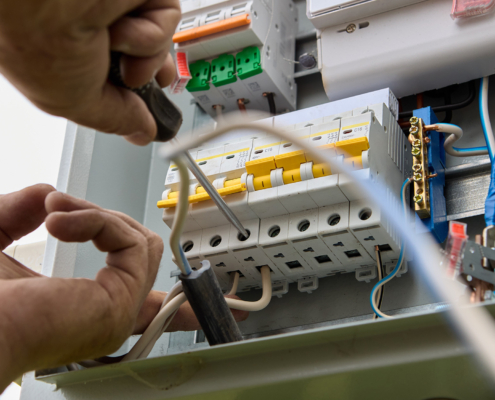
A generator is only as useful as the system that connects it to your building. A transfer switch is the component that isolates your facility from the utility grid and routes power from the generator when an outage is detected. For most commercial generator installations, an automatic transfer switch (ATS) is the preferred solution. An ATS monitors utility power continuously, detects a failure, starts the generator, and transfers the load automatically, without requiring manual intervention from your maintenance staff.

Integrating the generator and transfer switch with your existing electrical infrastructure requires careful coordination. For facilities going through a design-build electrical project, backup power systems can be incorporated from the ground up, which typically results in a cleaner and more cost-effective installation. For existing buildings, the electrical contractor will evaluate the current service entrance and panel configuration to determine the most practical integration approach for your specific facility.

Code Compliance and Permitting for Standby Generator Installation

Commercial generator installation in Utah must comply with the National Electrical Code (NEC) and NFPA 110, which governs performance and installation requirements for emergency and standby power systems. Local jurisdictions also require permits, post-installation inspections, and load bank testing to verify that the system performs at its rated capacity under real demand conditions.

These are not optional steps. Electrical code violations discovered after a standby generator installation is complete can require significant rework, delay your system from entering service, and create liability exposure for your facility. In Utah, permit applications typically require equipment specifications, site plans, and single-line electrical diagrams before approval is granted. Working with a qualified Utah electrical contractor who understands local permitting and inspection requirements from the start keeps your project on schedule and ensures your system is fully compliant when it goes into service.

Testing and Maintenance After Installation

The success of a commercial generator installation does not end at project completion. A system that passes installation inspection but never gets tested under load can still fail when it matters most. Regular testing and scheduled maintenance are what keep a backup power system performing reliably over its full service life.

Most industry standards and generator manufacturers recommend monthly exercise testing under load and annual load bank testing to confirm the unit can carry its rated capacity. Between those scheduled tests, generators require oil and filter changes, coolant checks, battery inspections, and connection verification. NFPA 110 specifically outlines testing and maintenance requirements for standby power systems, and meeting those standards is part of keeping your installation code-compliant throughout its service life. These tasks are a core component of a structured electrical preventive maintenance program, and facilities that skip them routinely find their systems fail to start when an actual outage occurs.

CTI Electric: Your Partner for Commercial Generator Installation in Utah

A commercial generator installation is a significant undertaking, and the outcome depends on working with a contractor who understands the full project scope: load analysis, equipment selection, transfer switch integration, code compliance, and long-term service. CTI Electric has been serving commercial and industrial facilities across the Greater Salt Lake Area since 1994. Our licensed team has the experience and local knowledge to design and install backup power systems that perform under real demand, meet every applicable code requirement, and come with a clear maintenance plan from day one.

Whether you are adding backup power to an existing building or planning a new commercial generator installation from the ground up, we can help you build a solution sized and configured for your specific operations. Contact CTI Electric to schedule a free site assessment and get a clear picture of what backup power looks like for your facility.

More Like This

Artificial intelligence (AI), machine learning and modern computer technologies concepts
Steel studs used to frame in a large commercial building
Tile roof with chimney and lightning protection system installed. Lightning rods. Close-up shot. Lightning conductor.
Lightning conductor on the roof of a commercial building
Commercial Electrical Maintenance for Reliable Construction
Side view of a man in a yellow hard hat conducting a building electrical inspection
Electrician checking connections in distribution board according to wiring diagram